KA200-035 · KING AIR 200/B200 · ATA 35
King Air 200/B200 Oxygen Systems and Maintenance Diagnostics
8 lessons
Trace the actual oxygen components and functions
10 practice cases
Compare supplied faults and test observations
2 maintenance jobs
Complete six supported decisions in each job
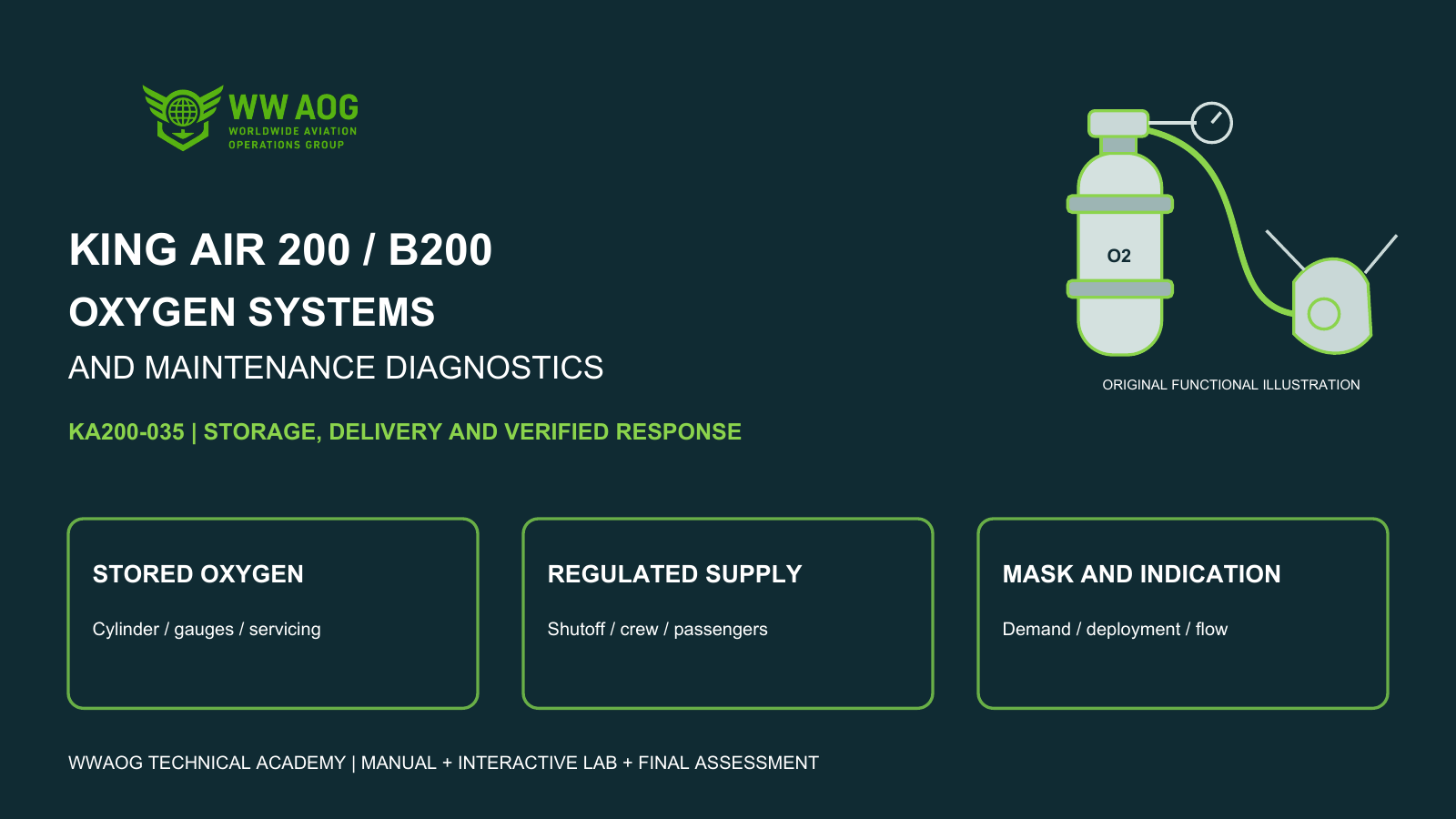
Understand oxygen storage, regulation, masks and the control relationships behind passenger deployment. The 40-page handbook and interactive lab include eight lesson decisions, ten two-part fault cases and two independent six-field maintenance jobs. The separate final has 40 questions and requires 80% (32 correct).
What's included?
-
8 system lessons with required decisions
-
10 two-part fault-isolation cases
-
2 independent six-field maintenance jobs
-
40-question final · 80% to pass
-
40-page illustrated study handbook
Follow the oxygen and identify the event
Separate stored-cylinder pressure from regulated delivery. Follow the crew and first-aid branches and the common passenger line. Distinguish pressure-operated door deployment, an individual lanyard valve, the barometric solenoid command and PASS OXY ON pressure-sense indication.
Use the test that answers the fault
Choose vented or unvented low-pressure isolation from the installed valve. Calculate stabilized decay for the actual connected volume. Keep high-pressure leakage, manual and substituted-command checks, and the three barometric methods with their own purpose and criteria. Systems and maintenance-decision training for the identified King Air 200/B200 oxygen installations in supplied Maintenance Manual 101-590010-19 Chapter 35, with its November 1, 2024 effective-page list. Serial, kits, cylinder/shutoff-valve and mask configuration determine the task. The study edition does not establish current aircraft applicability; actual work uses current controlled instructions. Recharge targets and recurring intervals remain in the applicable Chapter 12 and Chapter 05 tasks. Course completion records online systems study and assessment. Practical competence, maintenance authorization and regulatory qualification are separate.
Professional aircraft maintenance training and technical support for working technicians, aviation operators, and professional organizations worldwide.
REGIONAL STANDARDS AND SUPPORT
Our aircraft systems courses use manufacturer technical manuals to support pilots and maintenance personnel working in FAA- and EASA-regulated aviation. Training combines detailed system explanations, knowledge checks and interactive exercises for initial familiarization and recurrent study.
Copyright © 2026 WWAOG LLC. All rights reserved.